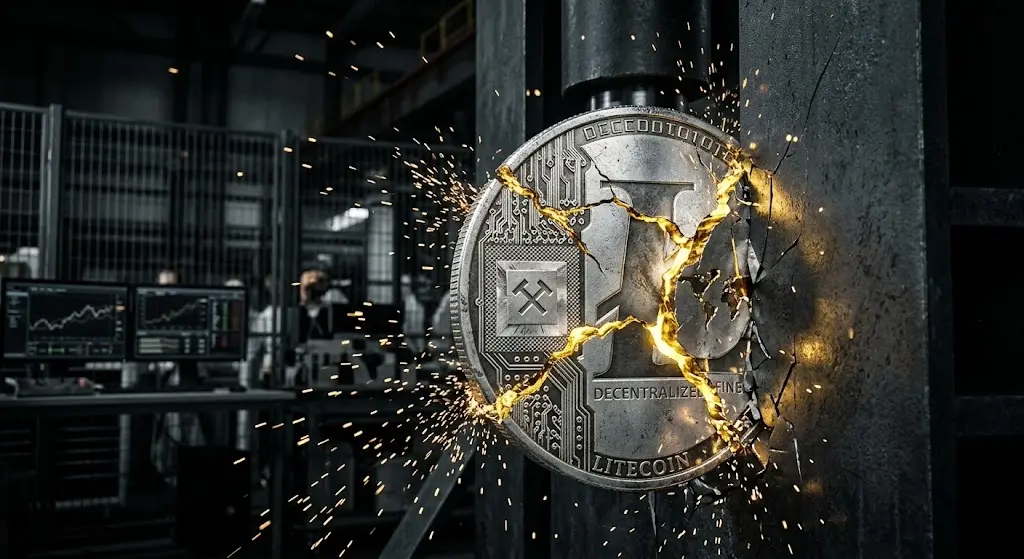
LAB RESULTS FOR TEST SUBJECT: LITECOIN (LTC)
- Investment Name: Litecoin (LTC)
- Hazard Warning: LEVEL 3 – HIGH
- Investment Type: Cryptocurrency – Altcoin (Not Bitcoin)
- Test Range: November 2024 to Present
- Total Litecoins Acquired: 26
- Baseline Entry/Cost Basis: $98 per coin
- Current Price: $42 (as of June 2026)
- Total Damage: – 57%
- CURRENT TEST RESULTS: DAMAGED BUT DURABLE
LAB NOTES: Despite the -57% drop, the network’s 14-year uptime remains intact, and the hash rate remains near all-time highs. The external shell is dented, but the engine is still running. Unlike the MSTY failure, there is no reverse-split risk here, just a pure test of patience and market cycles.
The Litecoin (LTC) Thesis
It was November 2024, and the United States elected what many consider the first crypto president. Bitcoin was approaching $100,000, and social media and the news were awash in crypto euphoria. That was when Litecoin caught my eye.
I was interested in crash testing altcoins, and Litecoin (LTC) seemed like the best fit for the test. Litecoin’s price was low enough to let me buy 26 whole coins, but not so low that it felt like investing in a memecoin subject to major pump-and-dump cycles.
Why I launched the LTC Experiment
All cryptocurrencies other than Bitcoin are referred to as altcoins, and in November 2024, I wasn’t looking to test another worthless altcoin.
I wanted a workhorse with a proven track record. I chose to crash-test Litecoin (LTC) because it has real utility and has been around since 2011. So, not only was I crash-testing an altcoin, but I was about to crash-test one of the oldest altcoins in existence.
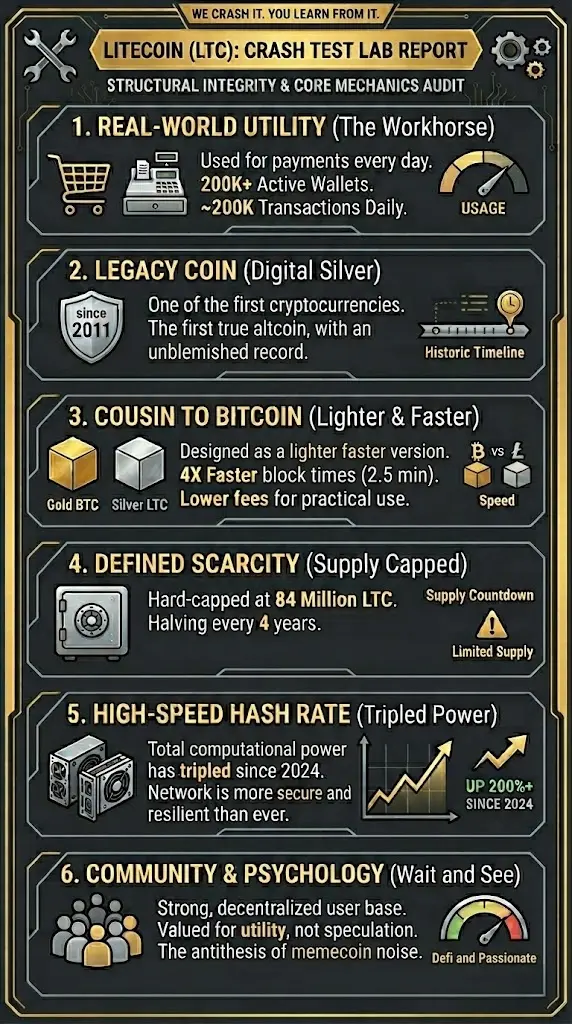
Here’s what Litecoin offered as an altcoin:
- Utility: Litecoin is actually used for payments. It has over 200,000 active wallets and processes nearly 200,000 transactions every single day.
- Legacy Coin: Launched in 2011, Litecoin is one of the first cryptocurrencies ever created. It is often considered the first true altcoin and has an unblemished 100% uptime record.
- Lighter & Faster: Designed as a lighter version of Bitcoin, Litecoin has 4X faster block times and lower fees.
- Scarcity: Total supply of Litecoins is capped at 84 million, and the mining reward is halved every 4 years.
- Strong Hash Rate: The total computational power of Litecoin has tripled since 2024.
- Community: Strong, decentralized user base that values utility, not speculation
Long story short, I wanted to crash test an altcoin with real utility and staying power, and Litecoin fit the bill.
Litecoin (LTC) Impact Analysis
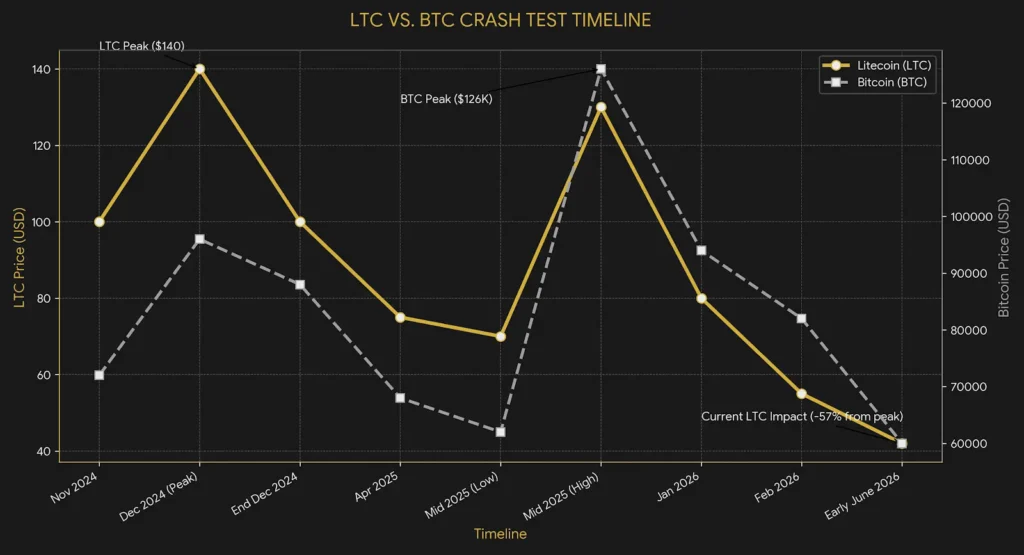
At first, I felt like a genius for choosing Litecoin. From November to December 2024, Litecoin rose from around $100 to almost $140. On paper, I was looking at a 40% gain in just one month, but the gain was short-lived.
By the end of December, Litecoin had crashed back down to $100, and by April 2025, it was sitting around $75. For the rest of 2025, it would ping-pong between $70 and $130, before the wheels finally fell off.
At the start of 2026, Litecoin was hovering around $80, but by February, it was down to $55. It found its footing around that price for the next few months, but it would not hold.
In June 2026, just as summer was starting and temperatures were rising, a crypto winter was setting in. In less than a week, Bitcoin lost $13,000, falling to $60,000. Unfortunately, Litecoin would follow Bitcoin down into the gutter.
As of early June 2026, Litecoin is trading at $42, and my crash-test position is down almost 60%.
What went wrong?
The biggest problem with my Litecoin crash test was that I was buying into the crypto hype. Leading up to and shortly after Trump’s election, all the stars were aligning for crypto.
A crypto czar was appointed, and a pro-crypto administration was put in place, including at the SEC. Crypto executive orders were being signed, and pro-crypto legislation was being introduced in Congress. Large institutions were tripping over each other to create crypto products with spot ETFs for Bitcoin, Ethereum, and Litecoin hitting the market.
Crypto had finally become mainstream. The 4-year cycle appeared over, and altcoins seemed to be stepping out of Bitcoin’s shadow. But all was not as it appeared to be. The altcoin season that typically follows a Bitcoin run-up never really materialized.
Altcoin season, or “altseason”, is the time when altcoins like Litecoin shine. It is when money rotates from Bitcoin into the altcoins, giving them a chance to outperform Bitcoin. While all the stars seemed to be aligned for an epic altseason, it never really got off the ground. A shinier object had arrived on the scene: AI.
AI swooped in and stole crypto’s day in the sun. Instead of money flowing into crypto and altcoins, it went into names like Nvidia and Marvell. In June 2026, when Bitcoin and altcoins were crashing, the tech-heavy NASDAQ was hitting all-time highs.
The large crypto balloon deflated, leaving my Litecoin position almost 60% smaller.
Why I’m Not Panicking: Dented but Durable
Before I bought 26 Litecoins, I knew the risks of investing in crypto, having lost 80% in a previous crypto crash test. It is an extremely volatile and speculative asset class, and my experience with it so far has been a losing one.
So, you might be wondering why I continue to hold Litecoin, given my loss of more than 50%. While the price has taken significant damage, Litecoin remains resilient, is performing at peak efficiency, and continues to increase its utility.
Here are the main reasons why I am still holding:
- Durability: Launched in 2011, Litecoin is a dinosaur among cryptocurrencies that refuses to go extinct. It has survived every major market crash with 100% uptime.
- Hash Rate Resilience: The Litecoin (LTC) network’s security is stable, with a hash rate near all-time highs despite the drop in Litecoin’s price.
- The LitVM (Litecoin Virtual Machine) Upgrade: Brings smart contracts to Litecoin and moves it away from solely being a payment processor. It is like Bitcoin meets Ethereum.
Of course, it also helps that my position in Litecoin is small, limiting my potential overall losses should things get worse.
The Psychology of the Hold
Seeing a -57% red mark on a “moonshot” can cause an emotional override. However, the goal of the Crash Test Money laboratory is to move beyond emotion and focus on the data.
This discipline didn’t come out of thin air. It was built on experience and principles outlined in my featured list, 5 Powerful Books to Conquer Money and Your Mind.
Specifically, two “Manuals” from that list are keeping this LTC experiment on track right now:
- Thinking, Fast and Slow (Daniel Kahneman): This book taught me about the two ways of thinking that Daniel Kahneman calls “System 1” and “System 2.” System 1 makes quick decisions with little thought, relying on past experiences and emotions. System 2 is slow and deliberate, requiring time and effort to reach a logical decision.
- The Little Book of Behavioral Investing (James Montier): Montier expands on Kahneman’s two systems (which he calls the X and C systems) and shows how they directly affect the way we invest. You will learn about the biases that influence our investment decisions. When you are done reading this book, you will never look at your investment decisions the same way again.
Final Verdict: Price is damaged, but the system is operational
Most people would see a 57% loss and run. In this lab, we treat it as a durability test.
I’m holding my 26 LTC because the network is doing exactly what it was designed to do: process payments without downtime. The market price is currently in the “crumple zone,” but the chassis and engine are solid.
The price has crashed, but the thesis hasn’t. Until the network utility fails or the 100% uptime record breaks, this experiment continues.
WE CRASH IT. YOU LEARN FROM IT.