THE MSTY ETF LAB REPORT: A -50% Collision with Reality
- Investment Name: YieldMax MSTR Option Income Strategy ETF (MSTY)
- Investment Type: Income – Uses an options strategy to generate cash
- Yield: > 100%
- Hazard Warning: LEVEL 4 – EXTREME
- TEST RANGE: June 2025 to December 2025
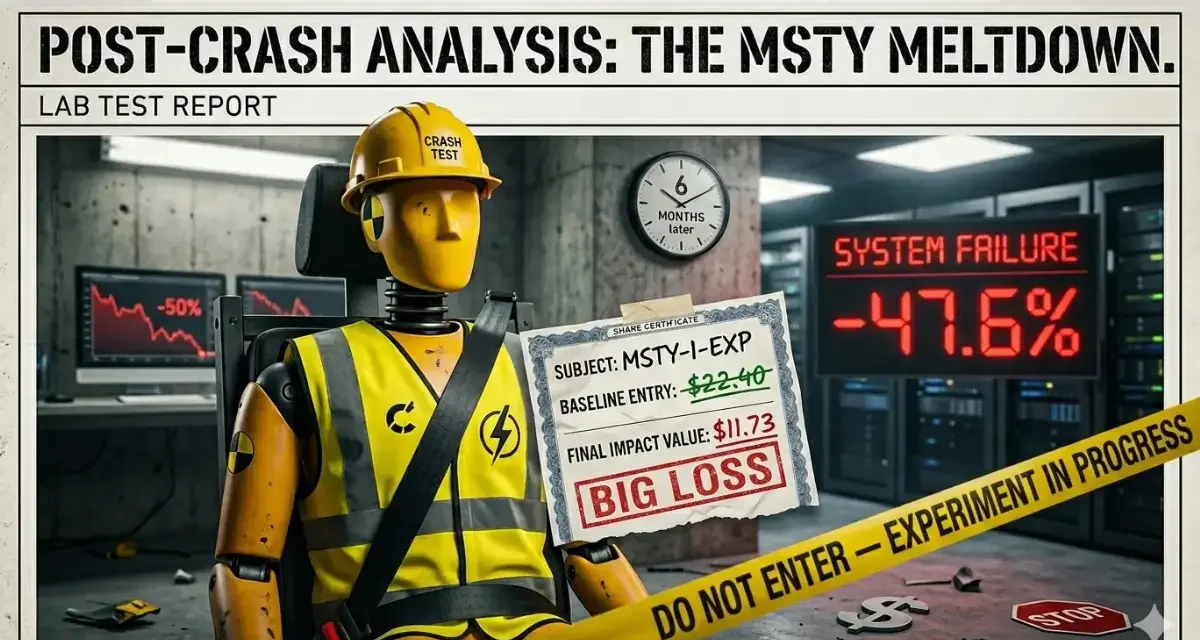
- Total Shares Acquired: 1
- Baseline Entry: $22.40
- Final Impact Value: $11.73
- Total Damage: -47.6%
- FINAL CRASH RESULTS: TOTAL WRECKAGE (Liquidation via Reverse Split)
RESEARCHER NOTES: Due to the extreme risk and volatility, we ran the “Single-Share Protocol,” which capped our total damage to $10.67. The massive dividend was alluring, but it could not offset the massive drop in MSTY. Ultimately, liquidation occurred following a 1-for-5 reverse stock split, as the fractional position failed to meet the new share threshold.
MSTY and Its High-Flying Dividend Make for an Epic Crash
The idea to buy MSTY happened in June 2025. Bitcoin was soaring, and Bitcoin maxis were having a field day on X, telling everyone to have fun staying poor. I clicked on a few Bitcoin posts, and before I knew it, my X feed became all about Bitcoin. That is when I first became aware of the YieldMax MSTR Option Income Strategy ETF (MSTY) and its insanely high triple-digit dividend yield.
That yield was like a piece of brownie staring me in the face. Add in the fact that the payouts were monthly (now weekly), and I could not resist the temptation and decided to run a controlled experiment.
I bought exactly one share of MSTY near the top of the most recent Bitcoin bull market. My idea with this “experiment” was to see how many shares I could accumulate by simply reinvesting the dividend. I wanted to see whether the NAV (Net Asset Value) could actually survive the aggressive payouts.
Spoiler alert: It didn’t. It was a nasty crash test and a lesson about the dangers of chasing yield and trends.
How the MSTY Engine Works (and Why It Overheats)
MSTY taps into the volatility of the Bitcoin treasury company Strategy (MSTR), formerly known as MicroStrategy, to deliver the mouth-watering monthly dividends.
To understand why MSTY crashed, you have to understand what’s under the hood. MSTY doesn’t actually own shares of Strategy (MSTR). Instead, it uses a synthetic covered call strategy to fuel the dividend payments.
The fund sells MSTR call options to other investors. Those investors pay MSTY a premium for the right to buy shares of the fund at a certain price. That premium is what pays investors the massive dividend. The fund, in turn, holds some U.S. Treasury bills as collateral to back its call strategy.
If all of this seems complicated, it is! This is an extremely risky strategy, which is why we put its hazard level at LEVEL-4 (Extreme).
Why MSTY Is So Risky
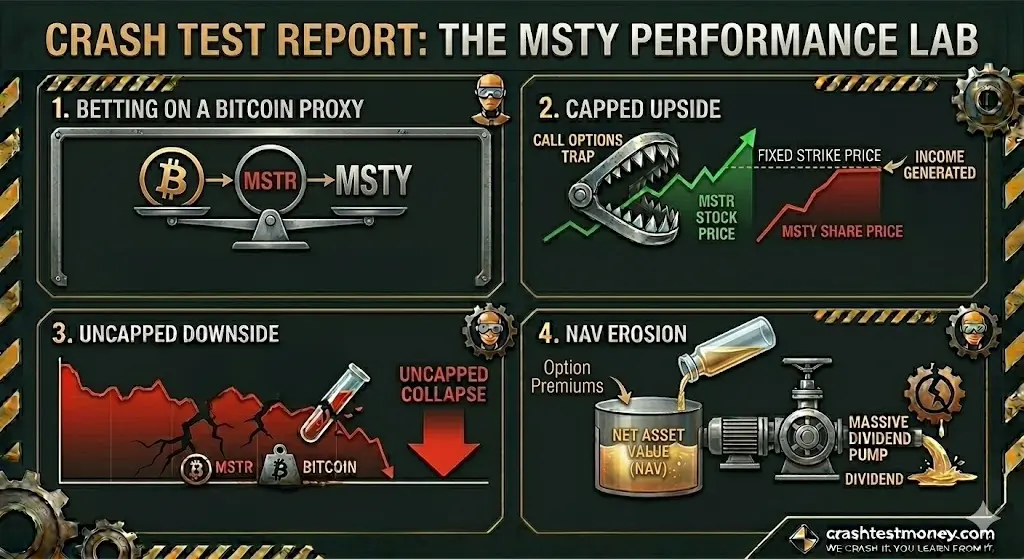
- Betting on a Bitcoin Proxy: MSTY is tied at the hip to Strategy (MSTR). MSTR is a leveraged bet on Bitcoin, since it uses debt to fund many of its Bitcoin purchases. Leverage amplifies volatility. If Bitcoin moves 5% in either direction, MSTR often moves 10-15% in the same direction.
- Capped Upside: Income is generated by selling MSTR call options. It doesn’t actually own MSTR stock or Bitcoin. When MSTR is rising, MSTY’s share price is capped by the strike prices of the options it sells.
- Uncapped Downside: If Bitcoin and by extension MSTR crash, MSTY takes a beating. I found this out the hard way. I bought one share of MSTY near the top of the Bitcoin bull market, and when it collapsed, I was down over 70% at one point. That’s including reinvesting the dividends!
- NAV Erosion: The massive payouts can easily exceed the premiums MSTY collects from its options strategy, putting a ton of downward pressure on its Net Asset Value (NAV). It only gets worse when MSTR stock drops, as it did in the second half of 2025.
As I soon discovered, my one-share MSTY “experiment” would become a victim of every single one of these risks.
The Anatomy of a 50% Crash
When I purchased my lone share of MSTY in June 2025, it was trading at $22.10 per share, about as much as a fast-food meal. I figured, what’s the worst that can happen? Instead of getting indigestion, I would be getting a massive monthly dividend.
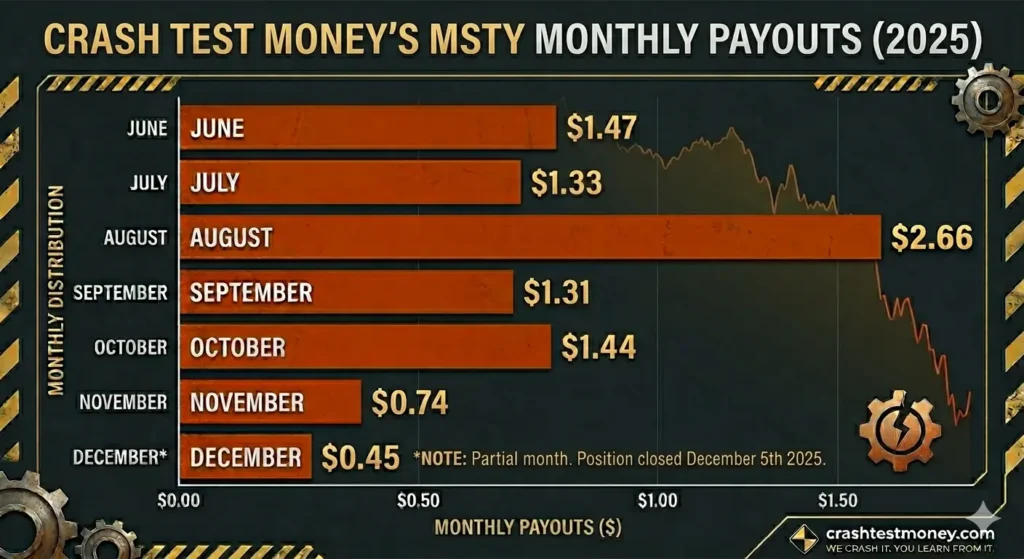
At first, the numbers looked amazing. I bought my one share of MSTY on June 4, 2025, and received my first dividend payout of $1.47 five days later. That amounted to a yield well over 6% in the first month of holding MSTY! At that rate, I was on pace to double my shares in the first year, which would only increase the payouts.
To put MSTY’s dividend in perspective, the average annual dividend yield of the S&P 500 is just over 1%, and for the Dow Jones, it is just around 2%. MSTY was blowing this away on a monthly basis, let alone on a yearly basis.
On paper, everything looked great. I was getting “paid to do nothing.” All I had to do was wait, reinvest the dividends, and my total number of shares I owned would keep accumulating. As my total number of shares increased, so would my total payout.
In reality, my investment sprang a leak. It was like filling a bucket with water that had a hole in it. While I was filling the top of the bucket with those dividends, the actual value of MSTY was leaking out the bottom.
By October, when Bitcoin reached its all-time high of $126,000, my investment in MSTY sprang a major leak. As December approached, Bitcoin and MSTR crashed, sending my MSTY position into freefall, down to nearly $7/share. My MSTY bucket was just about empty.
MSTY became a perfect example of the dangers of NAV erosion.
The Final Blow: The 1-for-5 Reverse Split
The plunging share price forced MSTY’s hand. It had to do something fast or risk becoming a penny stock. So it chewed some gum and stuck it in the hole to stop the leak.
The solution: In December 2025, MSTY performed a 1-for-5 reverse stock split to boost its net asset value (NAV), meaning an investor would receive 1 share for every 5 that they owned in MSTY.
Much like using chewing gum to plug a hole to stop a leak, a reverse stock split is not a permanent fix. Stock splits do not change the underlying value of your holdings. They are just a form of financial engineering used to manipulate share prices. Whether you own 5 shares at $1 each or 1 share at $5, the total value remains the same: $5.
In the case of MSTY, the stock was trading around $7 per share before the reverse split. At $7 per share, five shares of MSTY would have been worth $35 just prior to the reverse split. After the reverse split, those five shares would be consolidated into one share at $35 per share.
The problem for me is that I had fewer than 5 shares of MSTY despite reinvesting the dividends. That left me short shares to participate in the 1-for-5 reverse split. My broker would not give out a fractional share for the reverse split. Instead, they liquidated my position.
My “experiment” didn’t just lose money; it was forcibly closed. I paid $22.40 for the ride, reinvested the dividends, and left with $11.73, a 50% loss in just 6 months.
How Much Did I Make In MSTY Dividends?
During those brief 6 months of holding MSTY, I earned $9.40 in dividends. That is an absurdly high amount, given that it all came from an original investment of $22.40.
While earning $9.40 in dividends over six months on $22.40 seems pretty good, it wasn’t enough to stop a 50% loss and liquidation. Unfortunately, NAV erosion is real, and in the end, I was the one who ended up paying for it.
The MSTY Crash Test Verdict: Big Dividend. Big Loss.
When I first started this “experiment,” my goal was to reinvest the dividends and hold MSTY indefinitely to see how many shares I could accumulate from that one share. However, MSTY proved to be a high-octane yield trap.
While it can be a tool for sophisticated traders playing short-term volatility, as a “buy and hold” income play, it’s like using a chainsaw: It’s extremely risky.
Here’s what I learned from my one share “experiment”:
- Yield is Not Total Return: You can’t eat a 100% yield if the principal drops by 50%.
- NAV Erosion is Real: If the fund can’t maintain its Net Asset Value, the distributions are often just returning your own capital back to you.
- Mind the Split: Stock splits are just a form of financial engineering to manipulate a stock’s price. Small “test” positions can get liquidated when a fund hits the panic button and does a reverse split.
So, knowing what I know today, would I do it again?
Absolutely!
My $22.40 is gone, but the lesson that NAV is king was worth every penny. It was a small price to pay for such a valuable lesson.
Putting Money To The Test: Think you’ve found a safer, higher yield? Drop a comment below, and we’ll put it through the laboratory.