
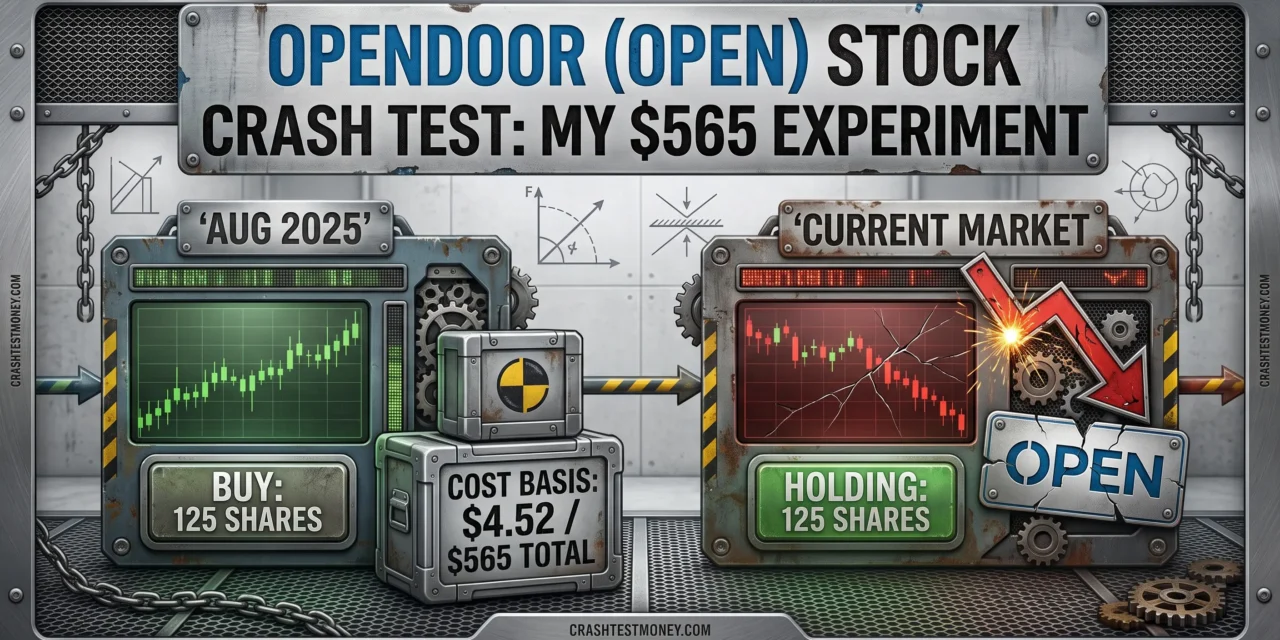
In August 2025, I decided to run a controlled crash test on a meme stock going viral on social media with retail investors. I bought 125 shares of Opendoor Technologies Inc. (NASDAQ: OPEN) at a cost basis of $4.52 per share, for a total investment of $565.
The core thesis of this Opendoor meme stock experiment was simple: test whether short-term retail sentiment and social media hype could overcome real estate macro headwinds and help a meme stock transition into a viable, profitable business over the long run.
Here is the trade ledger, performance metrics, and breakdown of what happened to this $565 experiment.
MEME STOCK CRASH TEST LOG: In August 2025, the Opendoor Meme Stock Experiment was initiated by acquiring 125 shares of Opendoor Technologies Inc. (NASDAQ: OPEN) at a cost basis of $4.52 per share, resulting in a total investment of $565. Experiment thesis is to test retail hype and social media sentiment against real estate macro headwinds. The position currently trades at $2.53 per share for total market value of $316, reflecting an unrealized loss of -$249 (-44%) while remaining in a HOLD status.
📊Opendoor (OPEN) Meme Stock Crash Test Summary Report
🧪Investment Thesis: Real Estate Meme Stock
Testing whether short-term social media hype can outrun macro housing headwinds long enough for a meme stock to build a viable, profitable business.
📊Cost Basis & Trade Ledger (COIN Stock)
| Test Parameter | Metrics & Values |
|---|---|
| Test Subject | Opendoor Stock (NASDAQ: OPEN) |
| Investment Type | Meme Stock (Real Estate Sector) |
| Test Date | August 2025 – Present |
| Hazard Warning | Level 4 – Extreme |
| OPEN Stock Purchase | 125 shares (August 2025) |
| Total Test Capital | $565 |
| Cost Basis | $4.52 per share |
| Current Value | $316 (as of September 2026) |
| Current Status | HOLD |
💥Loss Metrics & ROI Damage Assessment
- Current Results: REPAIR REQUIRED
- Current Loss: – $249
- Current Damage: – 44%
🔬 Damage Analysis
- Loss Is Contained: Because the initial buy was capped at $565, taking a 44% drawdown hurts on paper, but damage is contained.
- Housing Market Pressure: High mortgage rates and slow home sales are hurting Opendoor’s core business, overpowering any short-term hype from social media and retail buyers.
- CEO Overhaul Plan: New CEO Kaz Nejatian has launched an aggressive turnaround plan focused on cutting overhead, utilizing AI, and prioritizing quicker inventory turnover.
The X Factor: Swallowing Retail Hype
The initial idea for this crash test came when hedge fund manager Eric Jackson, known for his call on Carvana, posted on X that his firm, EMJ Capital, had taken a position in Opendoor. In his summer 2025 post, Jackson said Opendoor could become a 100-bagger and set an $82 price target. When Jackson made this announcement on X, Opendoor was trading under $1 per share.
As you can probably imagine, Jackson’s post caught my attention and a lot of attention from the retail investing community on X. Soon, diehard Opendoor retail investors began calling themselves the “Open Army,” and they were ready for battle. Before you knew it, the Open Army was waging a campaign for a new CEO and the return of the company’s founders on the board. Spoiler alert: They won.
The result: retail interest and speculation drove Opendoor stock straight up. It was a classic meme-stock trajectory, and I was ready to experiment with it.
In August 2025, I bought 125 shares of Opendoor (NASDAQ: OPEN), for a total investment of $565. The experiment: test whether retail and social media hype, along with a new CEO, could overcome real estate macro headwinds.
The immediate results? Not so good. But the experiment isn’t over. The new CEO, Kaz Nejatian, could still turn things around, but it won’t be easy.
Macro Realities: The iBuyer Model vs High Rates
Opendoor’s core iBuyer model of buying residential homes directly from sellers, making minor renovations, and reselling them is inherently sensitive to interest rates.
When mortgage rates are high and home transactions slow, the iBuyer business model faces significant pressure:
- Holding Costs: The longer homes sit on the balance sheet, the more Opendoor pays in property taxes, maintenance costs, and finance charges, which eat into profit margins.
- Pricing Inaccuracies: A rapidly changing housing market makes pricing models less accurate, challenging margins.
- Capital Squeeze: Unlike capital-light software businesses, buying and selling homes requires massive amounts of leverage, making Opendoor sensitive to high borrowing costs.
Retail hype on social media hasn’t been able to override these fundamental challenges with the iBuying model. It may have quickly sent OPEN soaring from under $1 to almost $10 per share, but since then it has been a slow downhill ride back to below $3 per share.
Despite all the retail hype in 2025, Opendoor’s revenue fell from $5.15 billion in 2024 to $4.37 billion in 2025, down sharply from its 2022 peak of $15.57 billion. As transaction volumes remained low, fundamental market pricing reasserted control, driving my test position down into its current -44% drawdown.
Strategic Rationale: Why Hold at -44%?
With the trade currently sitting at a $249 loss, the obvious question is: Why hold?
There are three key reasons why I am maintaining a HOLD status on this experiment:
- Assessing the Kaj Negatian Turnaround: With former Shopify COO Kaz Nejatian stepping into the CEO role, Opendoor is undergoing a dramatic operational reset that Kaz is calling “Opendoor 2.0”. Kaz is focused on cutting overhead, utilizing AI, and accelerating inventory turnover and acquisition velocity. Despite the less-than-stellar revenue numbers, Opendoor is showing signs of progress in these areas.
- Limited Damage: The position functions as a cheap, real-time case study in meme stocks. The worst-case scenario is a total loss of $565, so the damage from the current -$249 unrealized loss is contained.
- Waiting on a Housing Turnaround: Right now, Opendoor is operating in one of the toughest housing markets in years. If Kaz Nejatian can make Opendoor cash flow positive in this environment and execute his turnaround plans, Opendoor will be primed to take advantage of a housing turnaround if and when one occurs.